NGAOUNDÉRÉ 2025: AFFADA holds its first University of Peace
September 24, 2025
CPS – Guiding Young People to Peace and Ensuring a Drug Free Society in Liberia
October 24, 2025Promoting Peace and a Drug-Free Future in Liberia through the Do No Harm Approach
On September 21, 2025, the world celebrated the International Day of Peace (IDP). The International Day of Peace, established by the United Nations in 1981, is dedicated to strengthening the ideals of peace through non-violence and reconciliation. Each year on September 21, people across the world unite in reflection, dialogue, and action for peace.
The global theme for the 2025 International Day of Peace is “Act Now for a Peaceful World.”
This theme highlights the urgency of taking immediate, practical steps at community, national, and international levels to prevent conflict, build trust, and sustain peace in the face of global challenges.
In Liberia, the CPS Network marked the occasion by bringing together participants from the CPS Liberia Network, partners, stakeholders, communities, and young people to engage in conversations and activities that foster unity, peace building, and sustainable development.
This year’s celebration highlighted Liberia’s ongoing journey to sustain peace while addressing urgent challenges, such as drug abuse, youth empowerment, and national reconciliation.
Under the local theme, “Sustaining Peace in Liberia: United for Reconciliation and a Drug-Free Future,” a panel discussion concluded the indoor program, with three selected panelists discussing Liberia’s reconciliation and a drug-free future from the perspectives of Do No Harm, Trauma Healing, and Reconciliation.
The panel discussion also centered on the work of youth organizations to ensure a drug-free Society. Mr. Samuel Darpolor, a development worker and Do No Harm expert, served as one of the panelists during a discussion on “The Do No Harm Perspective of Sustaining Peace in Liberia: United for Reconciliation and a Drug-Free Society.” He explained that the ‘Do No Harm’ approach is a development principle that emphasizes the importance of ensuring interventions do not exacerbate existing challenges within communities.
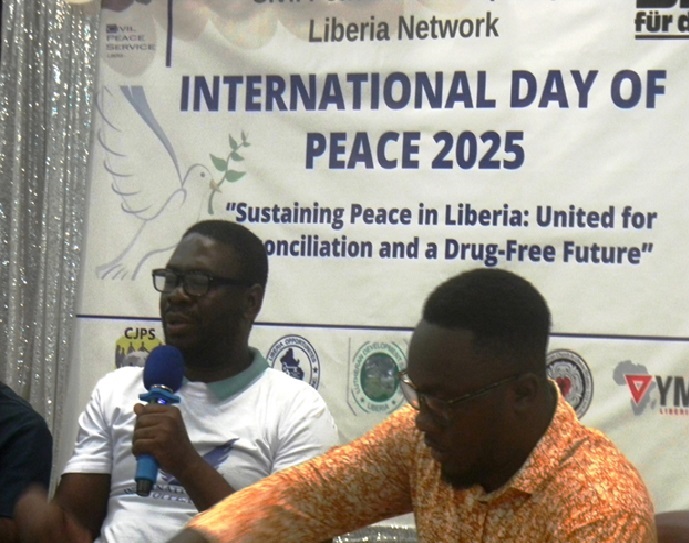
Mr. Darpolor emphasized that the goal of applying the Do No Harm approach is to ensure that interventions do not create new problems. He noted that while development efforts are often carried out with enthusiasm and the expectation of positive results, poorly executed actions can sometimes worsen situations rather than resolve them.
Sustainable Peace in Liberia: How Does the No Harm Principle Help Shape Development
Mr. Darpolor cautioned the gathering that Liberia’s peace remains fragile and could easily be disrupted if not carefully safeguarded. He questioned why peace in Liberia is still considered fragile, despite the country’s history of multiple elections and democratic processes. He noted that fragility typically stems from underlying issues such as weak institutions, limited economic opportunities, persistent corruption, and social divisions, which can undermine the gains made through democratic transitions.
Furthermore, he questioned whether peace is truly being experienced by all Liberians, asking: “If we are genuinely at peace, why then do we see growing disenchantment with political parties and other groups?”
He observed that recent developments suggest certain missteps from the early stages of the peace process continue to keep Liberia on edge. “Do No Harm calls for deep reflection to identify where mistakes were made during the peace process,” he added.
Mr. Darpolor stressed that reconciliation is a pressing demand from the Liberian people, noting that true national progress cannot be achieved without it. “Liberians are calling for reconciliation, and if this country must move forward, that process must also address the issue of justice,” he said.
He questioned the fairness of perpetrators occupying top government positions and living in comfort while many of their victims continue to suffer in poverty. “How can reconciliation be possible in such circumstances? Where is Liberia’s reconciliation?” he asked.
Mr. Darpolor further observed that attempts to pursue justice—whether through prosecuting corrupt officials or holding people accountable—are too often dismissed as witch hunts.
Mr. Darpolor emphasized that for Liberia to truly advance reconciliation, citizens must understand the steps and approaches involved, as well as how the process can positively impact communities without reopening the wounds of the war. He also addressed the country’s ongoing drug crisis, noting that while calls for the rehabilitation of drug users are important, the focus must go beyond rehabilitation alone. “Some individuals turn to drugs due to a lack of job opportunities, so addressing these underlying causes is essential,” he said.
“After rehabilitation, will there be job opportunities to prevent individuals from returning to drugs? Where are the Do No Harm experts? Where are the drug dealers?” He asked.
From a development perspective, Mr. Darpolor urged Liberians to critically analyze the country’s unique context when addressing peace, reconciliation, and the fight against drugs. He emphasized that Liberia should not simply replicate how other countries tackle these issues, but instead develop strategies tailored to its own realities. “Relying solely on awareness campaigns or rehabilitating a few individuals is insufficient. A careful analysis and thorough research are needed to achieve informed and lasting results,” he concluded.